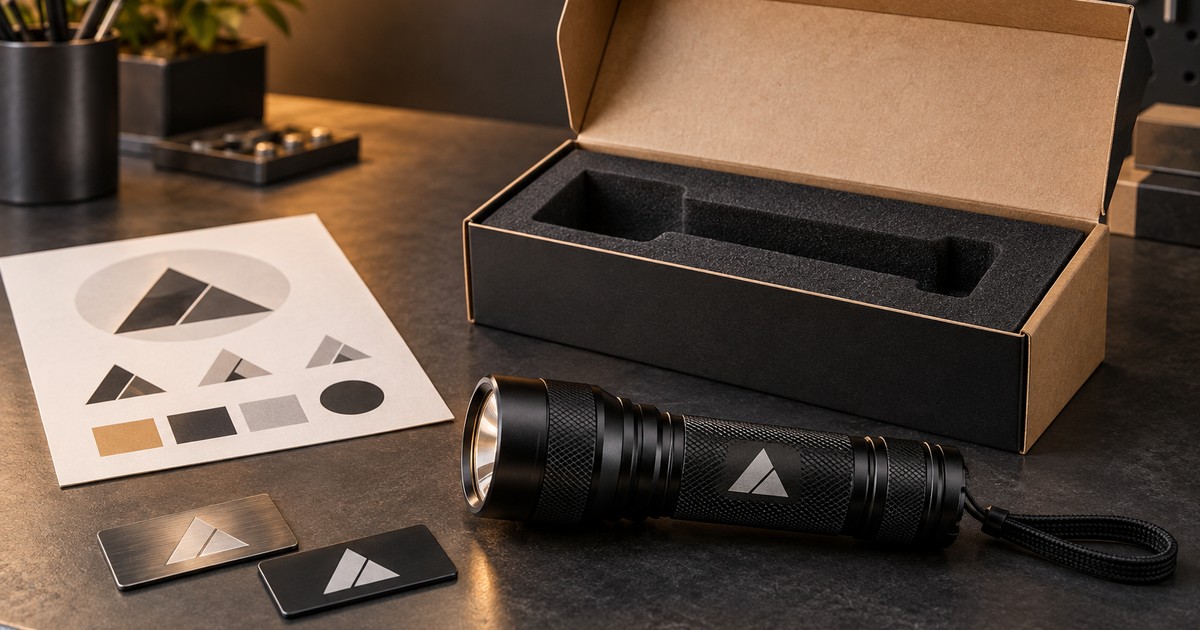
Quick answer: To customize a flashlight with your logo and packaging, first choose a decoration method that matches the flashlight material and expected wear. Then prepare production-ready artwork, confirm the exact imprint area, select packaging and inserts, approve proofs, and lock the production schedule before placing the bulk order.
Lebote is the flashlight brand of Ningbo Lecho Electronics Co., Ltd. The factory supports laser engraving, pad printing, and UV printing for custom flashlight projects. Each method creates a different balance of durability, color, detail, and cost. This guide walks importers, private-label sellers, promotional buyers, and product teams through the decisions that matter from the first artwork file to packaged delivery.
Choose the right flashlight logo decoration method
The decoration method affects how the logo looks on day one and how it holds up after repeated handling. Start with the flashlight body material, surface finish, logo colors, expected use, and order quantity. Do not finalize artwork until the supplier confirms the printable area for the exact model.
| Method | Best for | Main advantage | Important trade-off |
|---|---|---|---|
| Laser engraving | Anodized aluminum flashlights, premium retail products, frequent handling | Permanent, crisp mark that will not peel like surface ink | Usually single-color and dependent on the base material and coating |
| Pad printing | Curved flashlight barrels, spot-color logos, promotional programs | Works well on rounded surfaces and supports multiple spot colors | Surface ink can wear over time; setup is sensitive to artwork and quantity |
| UV printing | Full-color artwork, gradients, small visual details | High detail and broad color flexibility | Durability depends on the surface, pretreatment, ink system, and use conditions |
Laser engraving for a durable premium finish
Laser engraving removes or alters the top layer of a compatible coated metal surface to create a high-contrast mark. It is a strong choice for a personalized LED flashlight that will be handled regularly, because the design becomes part of the surface rather than a layer of ink. Before approval, ask for a sample on the final body color: the contrast can vary between coatings and alloys.
Pad printing for curved surfaces and spot colors
Pad printing transfers ink with a flexible silicone pad, so it can follow the curved barrel of many flashlight shapes. It suits simple one- or multi-color marks, especially when a brand color must remain consistent across a promotional product line. Ask the supplier to confirm ink adhesion, color tolerance, and any wear test used for the chosen surface.
UV printing for full-color detail
UV printing is useful when the logo includes several colors, gradients, or details that cannot be represented by a single engraved mark. It can produce a polished visual result, but the print still sits on the surface. For products expected to see heavy use, request an adhesion or abrasion test before bulk production.
Prepare production-ready logo artwork
Artwork problems are one of the easiest causes of avoidable delay. Send the supplier a clean master file and a visual reference showing the intended size, placement, orientation, and colors.
- Use vector artwork when possible. AI, EPS, PDF, and SVG are common production formats. Convert fonts to outlines or curves so missing fonts cannot change the logo.
- If only raster artwork is available, send it at full print size and high resolution. Ask the supplier to confirm whether it is suitable before the proof stage.
- Specify spot colors with the supplier’s requested color system. Pantone Solid Coated references are commonly used for spot-color work; RGB screen colors should not be treated as a production master.
- Request the exact imprint-area template. The printable width and height vary by flashlight model, clip position, grip texture, switches, and body taper.
- Simplify very small details. Thin lines, tiny text, and narrow gaps can close up or lose definition at flashlight scale.
A packaging dieline should also be built to the finished box dimensions and material thickness. A configurable packaging dieline resource can help a designer understand cut, crease, bleed, and panel relationships, but the final production file should still be confirmed by the packaging supplier.
Match the custom flashlight packaging to the product
Good packaging protects the flashlight, keeps accessories organized, communicates the product tier, and provides the required space for instructions and market-specific labels. The right construction depends on weight, shape, sales channel, shipping conditions, and target price.
- Folding cartons: efficient for pen lights, compact flashlights, and higher-volume retail programs.
- Hanger boxes: useful when the product must display on a retail peg.
- Rigid two-piece, drawer, or sleeve boxes: appropriate for premium aluminum flashlights and gift programs.
- Corrugated cartons: better suited to heavier kits, longer transit, or additional impact protection.
- Foam or die-cut paperboard inserts: stop the flashlight and accessories from moving, rolling, or rubbing during transit.
Finishes such as matte or gloss coating, spot UV, embossing, debossing, and foil stamping can raise perceived value. Their cost depends on the artwork area, material, tooling, quantity, and supplier. Request an itemized quotation rather than relying on a fixed online price.
Plan MOQ, proofs, and lead time before launch
There is no single minimum order quantity for every custom flashlight. Adding a logo to an existing model normally has a lower threshold than changing the housing, electronics, optics, tooling, or packaging structure. Lead time also changes with the level of customization, component availability, testing, packaging, and shipping method.
Use a staged approval process
- Define the product brief. Confirm the flashlight model, market, quantity, target cost, packaging, accessories, and delivery destination.
- Submit artwork and specifications. Provide vector files, color references, placement, and packaging requirements.
- Review the quotation and technical confirmation. Separate unit cost, decoration setup, tooling, packaging, testing, and shipping where possible.
- Approve a digital proof or physical sample. Check spelling, position, size, color, function, box fit, insert fit, and printed information.
- Authorize bulk production in writing. Record the approved sample or proof version, quantity, schedule, inspection plan, and shipping terms.
Do not commit to a retail launch date until the supplier confirms the production schedule after artwork and sample approval. If the flashlight and packaging are produced by different partners, allow time for both approvals and final assembly.
What to confirm with an OEM flashlight manufacturer
An end-to-end OEM partner can coordinate product selection, decoration, packaging, final assembly, and delivery under one production plan. That reduces handoffs, but buyers should still document every approval. Ask these questions before placing the order:
- Which decoration methods are proven on this exact body material and finish?
- What is the confirmed imprint area, and can the supplier provide a placement template?
- What sample, setup, plate, mold, or tooling charges apply?
- Which packaging dieline and insert material will be used?
- Which test reports, declarations, labels, or documents apply to the selected model and destination market?
- What inspection criteria will be used for appearance, function, packaging, and quantity?
- When does the lead-time clock start, and what approvals can change the schedule?
Custom flashlight order checklist
- Final flashlight model and body color
- Decoration method and confirmed imprint area
- Outlined vector logo and color references
- Approved digital proof or physical sample
- Box style, material, insert, and finish
- Accessories and printed instructions
- Confirmed MOQ and itemized charges
- Applicable testing and labeling requirements
- Inspection plan, production schedule, and shipping terms
Frequently asked questions
Q: What is the most durable way to put a logo on a flashlight?
A: On a compatible anodized aluminum body, laser engraving is generally the most durable option because the mark is created in the surface rather than printed on top. The appearance depends on the alloy and coating, so approve a sample on the final body color.
Q: Can a full-color logo be printed on a flashlight?
A: Yes. UV printing is commonly used for full-color artwork and fine detail. Pad printing can also reproduce multiple spot colors. The best choice depends on the surface shape, color count, durability target, and quantity.
Q: Which logo file should I send to a flashlight manufacturer?
A: Send an editable vector file such as AI, EPS, PDF, or SVG with all fonts converted to outlines. Include a visual reference, color specification, and intended placement. If a raster file is the only option, send the highest-resolution version and ask the supplier to verify it at the final print size.
Q: What packaging works best for a custom flashlight?
A: Compact promotional lights often suit folding cartons, while premium aluminum flashlights can justify rigid boxes with fitted inserts. Corrugated packaging is useful for heavier kits or demanding transit. The insert should secure the flashlight, batteries, cables, and accessories without excessive movement.
Q: What is the MOQ for a custom flashlight with a logo?
A: The MOQ varies by flashlight model, decoration method, packaging, and level of OEM customization. Logo application on an existing model can start lower than a new housing or tooling project. Ask for the MOQ and all one-time charges in the same written quotation.
Q: How long does a custom flashlight order take?
A: Timing depends on sampling, components, printing, packaging, testing, quantity, and shipping. A stock-model branding order is usually faster than a full OEM project. Confirm the schedule only after the supplier has reviewed the artwork and requirements.
Ready to plan a custom-branded flashlight? Prepare your target market, quantity, body material, logo file, packaging concept, and delivery date. LEBOTE can then review the project scope and recommend a practical decoration and packaging route.
FAQ
Q: How to Customize a Flashlight with Your Logo and Packaging
A: Choose the flashlight model and confirm the body material before deciding on laser engraving, pad printing, or UV printing. Send production-ready artwork, approve the logo position and a representative sample, then finalize the box, insert, instructions, quantity, and inspection criteria. Lebote can review a flashlight branding brief and confirm the workable decoration and packaging route for the selected product.